



Google reviews disappearing: why it happens and what to do
Reviews disappear for policy, reviewer or listing reasons. Learn how to tell them apart, read the removal rate, and keep the evidence Google deletes.
Last updated:
A review you read on Monday is gone on Thursday. The star average moves by a decimal, the review count drops, and the only copy of what the customer wrote is a screenshot someone took in a group chat. The first instinct is to call it a glitch. It is rarely a glitch.
Reviews disappear for a small number of reasons, and each one asks something different of you. Some removals are Google enforcing its own content policy. Some are the customer changing their mind. Some are a side effect of a listing being merged, moved or closed. Treating all three as "Google deleted a review" hides the only part you can act on: the pattern behind the removals.
What does it mean when a Google review disappears?
Google does not send a detailed notice for every removal, and it does not owe you an explanation. What you get is an absence: a count that no longer matches, a rating that shifts, a review link that stops loading. That is why the archive matters more than the alert. You cannot recover what nobody kept.
The removal reasons worth telling apart
Google's prohibited-content policy covers fake engagement, off-topic reviews, restricted or illegal content, impersonation and conflicts of interest. Enforcement is automated first and reviewed later, which is why removals often arrive in batches rather than one at a time.
| What happened | What you see | What you can do |
|---|---|---|
| Policy enforcement on content Google classifies as spam or prohibited | One or several reviews gone without notice; often a cluster around the same week | Keep the archived copy, fix the practice that produced the reviews, flag anything still live that breaks the same rule |
| The reviewer deleted or edited the review | A single review disappears, or its star rating changes | Nothing to restore; the archive keeps the original text and rating |
| A listing was merged, moved or marked closed | Reviews vanish with the old listing, or appear under a different one | Check for duplicates and confirm the merge was deliberate |
| Ownership or account changes | Reviews no longer appear in the account you use | Verify access and run the alerts check before assuming removal |
| A suspicious cluster of 5★ reviews was cleaned up | Several positive reviews disappear on the same day | Review how reviews are requested; never buy or incentivise them |
The distinction matters because only the first row is about Google's judgement of content. The third and fourth rows are your own housekeeping, and they are far more common after a relocation, a rebrand or an agency change than most teams expect.
A removed review is still evidence
A review that is gone from Google is not gone from the business. It tells you what a customer experienced, whether anyone answered, and whether the same complaint is repeating at other locations. Five questions are worth answering while the archived copy is still fresh:
- What exactly was said? The theme, not the tone. "Waited 40 minutes" and "staff were rude" route to different teams.
- When did it arrive? A removal date next to the visit date shows how long the review was live and whether it was ever seen.
- Was it answered? An unanswered negative review that later disappears is still an unanswered complaint.
- Does it repeat? One removal is an event. Six removals with the same theme across three locations is an operations finding.
- Did the removal change a number you report? If the average rating moved after the removal rather than after new reviews, the report needs a footnote.
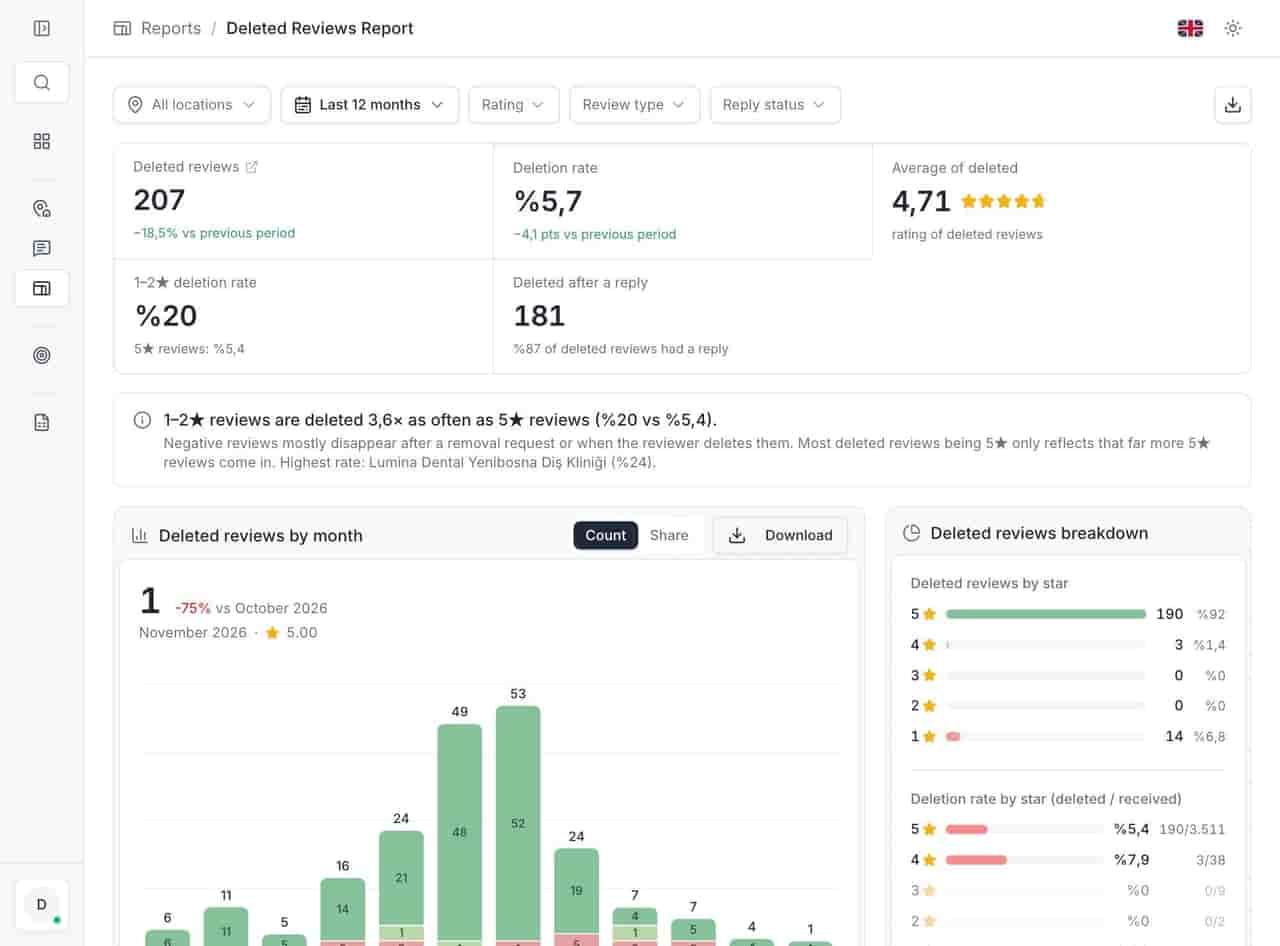
In the anonymized 23-location demo account behind this site, 9,749 reviews were tracked and 207 of them — 5.7% — were later removed by Google. Within the 1–2★ band, the removal rate was 20%. Those are sample figures from one account, not a benchmark for your industry, but they show why the denominator matters.
Read the rate, not the count
"The review was deleted" is not a finding. "Twenty percent of this location's one- and two-star reviews were removed in the last quarter" is. A count has no denominator; a rate does.
Two habits make the rate readable:
- Split by star band. Removals concentrated in the low band flatter the average without anyone improving service. Removals spread evenly across all bands look more like routine policy enforcement.
- Compare locations, not months. A single location with an unusual removal rate is worth a conversation. Every location moving in the same week usually means a policy or account event, not six coincidences.
This is the uncomfortable part of review analytics: a rising rating can be a removal statistic wearing a quality costume. That does not make the rating worthless. It makes the footnote necessary.
What not to do when a review disappears
- Do not ask for replacement reviews in a burst. Ten five-star reviews arriving the day after a negative one disappeared is the pattern Google's systems are built to notice.
- Do not buy reviews or offer a discount for one. It breaches Google's policies and turns a missing review into a listing-level risk.
- Do not accuse the reviewer in public. You cannot prove who removed what, and the reply is read by future customers.
- Do not treat the disappearance as a resolved complaint. The customer's experience did not change because the text did.
- Do not rely on screenshots in chat. A record that lives in three inboxes is not a record. The deleted reviews archive exists because the copy has to outlive the review.
A four-step routine that survives a removal
- Archive before you need it. Connect the account and let the archive start with the reviews that exist today. A review removed six months from now can only be read from a copy taken before the removal.
- Export the removed list monthly. One export per period, with location, rating, date and reply status. It takes minutes and settles most internal arguments.
- Tag the theme, not just the star. Parking, waiting time, a named process, a product. Themes are what operations can fix.
- Report the rate beside the rating. A monthly pack that shows the average without the removal rate is telling half the story — and review analytics is where the two belong together.
Checklist before you close the case
- The original text, rating, date and location are archived.
- The review's reply status is recorded, even if the review is gone.
- The removal is classified: policy, reviewer action, listing change or account change.
- The theme has an owner outside marketing.
- The rating change is reported with the removal rate, not on its own.
- Any still-live review breaking the same policy has been flagged.
- The customer has a route back if they contact you again.
The record is the point
You cannot control which reviews Google keeps. You can control whether the business remembers them, whether the same complaint is answered, and whether a rating is reported honestly. A disappeared review is a loss of public text, not a loss of evidence — unless nobody kept a copy.
For a clinic or a veterinary practice, the stakes are higher: a removed review may be the only record of what a patient described, and the reply rules are stricter. The clinic guide covers the wording boundary. For the reply itself, start with the rules and templates rather than improvising under pressure.
If you want to see how many reviews your locations have already lost, connect one Google account and open the deleted reviews report. The number is usually larger than the team expects.
Questions, answered.
Can I get a removed Google review back?
Why do several reviews disappear at once?
Does a removal change my rating?
See how the deleted reviews archive keeps the record, including the reply.
FeaturesKeep reading
Related
Related pages
Features, sectors and reading that share the same work.