



How to reply to a negative Google review: rules and 6 templates
Three rules and six copy-ready templates for negative Google reviews, plus how to spot a fake review and when waiting is the better first move.
Last updated:
A negative review is read by two audiences. The person who wrote it may never come back. The next customers will read both the complaint and your answer before they decide. That second audience is the reason to reply at all — not to win the argument, but to show a stranger how you behave when something goes wrong.
Most bad replies defend the rating, disclose private detail or promise action nobody has taken. The rules below remove those failure modes; the templates are starting points, not scripts.
What makes a good reply to a negative Google review?
The test: would a future customer trust you more after reading it? If the reply is mainly about how unfair the review is, no.
Three rules that keep a reply safe
1. No personal or account detail
Do not confirm an appointment time, an order number, a treatment, a policy number or an address. Even confirming that someone is a customer can be a disclosure. Reply to what the review already made public, and move the specifics to a private channel. Privacy rules in the UK and EU apply to what a business publishes, including replies; if a case is sensitive, ask your own adviser before writing.
2. No clinical or regulated detail
Clinics, veterinary practices and financial services carry a higher bar. Never confirm that someone was a patient, never discuss a diagnosis or treatment, and never imply that a complaint is medically wrong. "We cannot discuss individual cases publicly" is a complete sentence, not an evasion. The clinic and veterinary guides go further on sector wording.
3. Do not defend the rating
You can correct a fact. You cannot argue someone out of feeling that the wait was too long. Start with the experience, not with the stars. If the review contains a factual error that matters — wrong branch, wrong service — correct it once, without repeating the accusation.
Six templates for six situations
Use the brackets as decisions. Do not send a sentence about an action you have not taken, and replace the contact route with one that a person actually monitors.
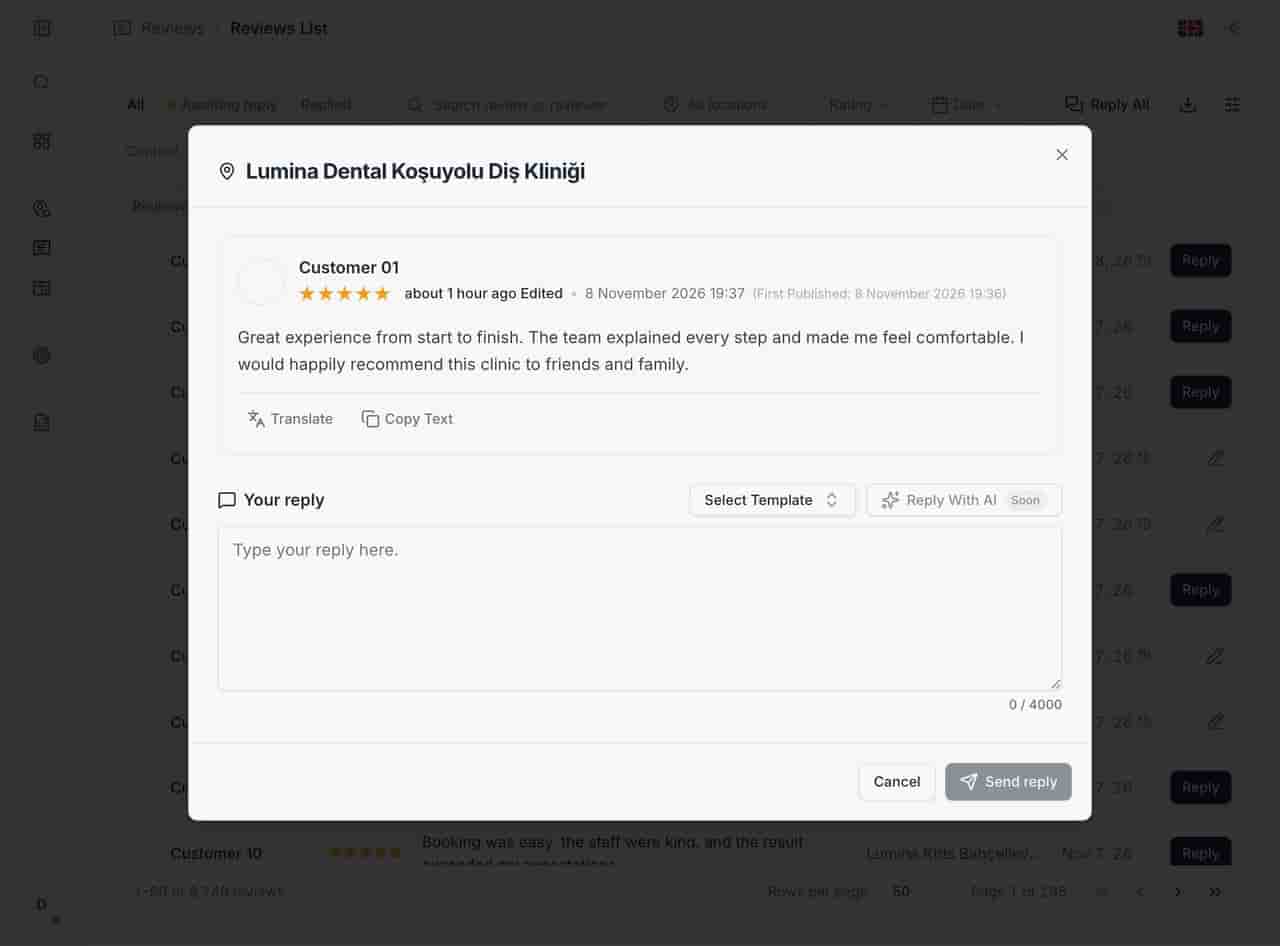
Waiting time or a late appointment
How a member of staff behaved
Price or an unexpected charge
Product or service quality
Cleanliness or premises
A serious complaint: safety, injury or a legal threat
For this category, involve a manager before publishing. A public reply can become evidence, and "we are investigating" is safer than a conclusion you cannot support. If legal action is threatened, take advice; the reply can wait a day.
When the review may be fake
Fake reviews are hard to prove from the outside, and accusing a reviewer in public usually makes the business look worse. Look for patterns rather than one review: no detail about a visit, a reviewer whose history spans unrelated cities, identical wording across several profiles, a cluster of one-star reviews arriving on the same day, or a complaint about a service the location does not offer.
What to do:
- Flag the review through Google's reporting process, one review at a time, with the reason that fits.
- Reply once, factually: "We cannot find a record that matches this visit. If you did visit, please contact [address] so we can look into it." Do not call the person a liar.
- Record the case. If removals cluster around one location or one week, that is a pattern worth escalating — and worth checking against the deleted review archive rather than memory.
- Never offer an incentive to remove a review. It breaches Google's policies and converts a bad review into a policy problem.
When not to reply — and how long to write
When silence is the better first move
Wait before replying when the review contains another person's personal data, an allegation you have not verified, or a threat of legal action. Report it, involve the right person, then reply to the part you can address. Waiting a day is not the same as ignoring it.
Some reviews cannot be satisfied: the one-line rant with no specifics. Answer for the audience, not the author. One factual sentence and a contact route is enough.
The 4,000-character question
Google allows replies up to 4,000 characters. That is a ceiling, not a target. Fifty to 120 words covers almost every situation: acknowledgement, one specific detail, one action, one route. Longer replies bury the apology and read as defensive. If the facts are complicated, the public reply should say less and the private conversation should carry the detail.
Write in the language of the review. Translation helps you read it; it does not excuse an answer the customer cannot understand. Reply under the correct location — a reply about the wrong branch is worse than none, which is why one inbox with the location on every review matters at scale.
A checklist before you press send
- The reply names the specific experience, not just "your feedback".
- No appointment, order, treatment, policy or address is disclosed.
- The tone is sorry for the experience, not defensive about the rating.
- Any action mentioned has actually been taken or is clearly marked as next.
- One private contact route, monitored by a named person.
- The reply is in the customer's language and under the right location.
- It is 50–120 words unless the case genuinely needs more.
- A second person has read it if the complaint involves safety, health or law.
Reply as if the next customer is reading
Because they are. A good reply does not erase a one-star review; it changes what that review says about the business. Keep the rules, adapt the templates, and review the pattern monthly: the same complaint arriving at five locations is an operations problem, not a copywriting one. Response templates keep the approved wording in one place, and review analytics shows whether response time is improving or just being measured.
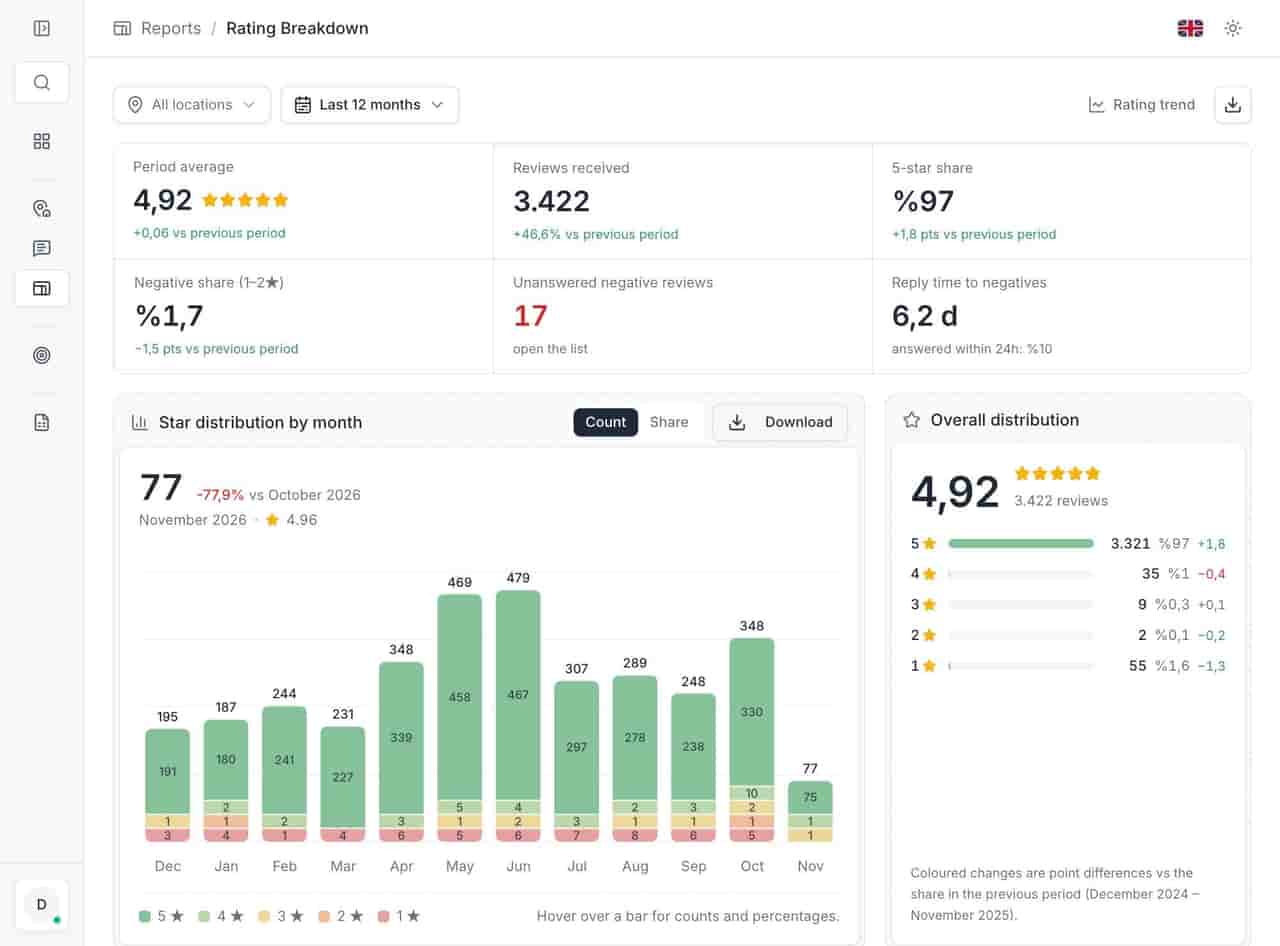
If you are handling reviews across dozens of locations, start with the multi-location process so the reply does not depend on one person's inbox.
Questions, answered.
How quickly should we reply to a negative review?
Should we reply to every negative review?
Can we ask a customer to remove a review?
See how the deleted reviews archive keeps the record, including the reply.
FeaturesKeep reading
Related
Related pages
Features, sectors and reading that share the same work.