



Visibility and reporting
Local rank tracking for every location and keyword
A ranking is a local result, not a national one. Local rank tracking records where each location stands for the keywords you choose, reports the average across the set, and shows the estate on a map so weak markets are visible.
Last updated:
What is local rank tracking in Locationes?
The position a specific location holds for a specific keyword, rather than one national number. You define the keyword set, apply it across locations, and read average position alongside a per-location and map view — the measure a contract or a monthly report usually asks for.
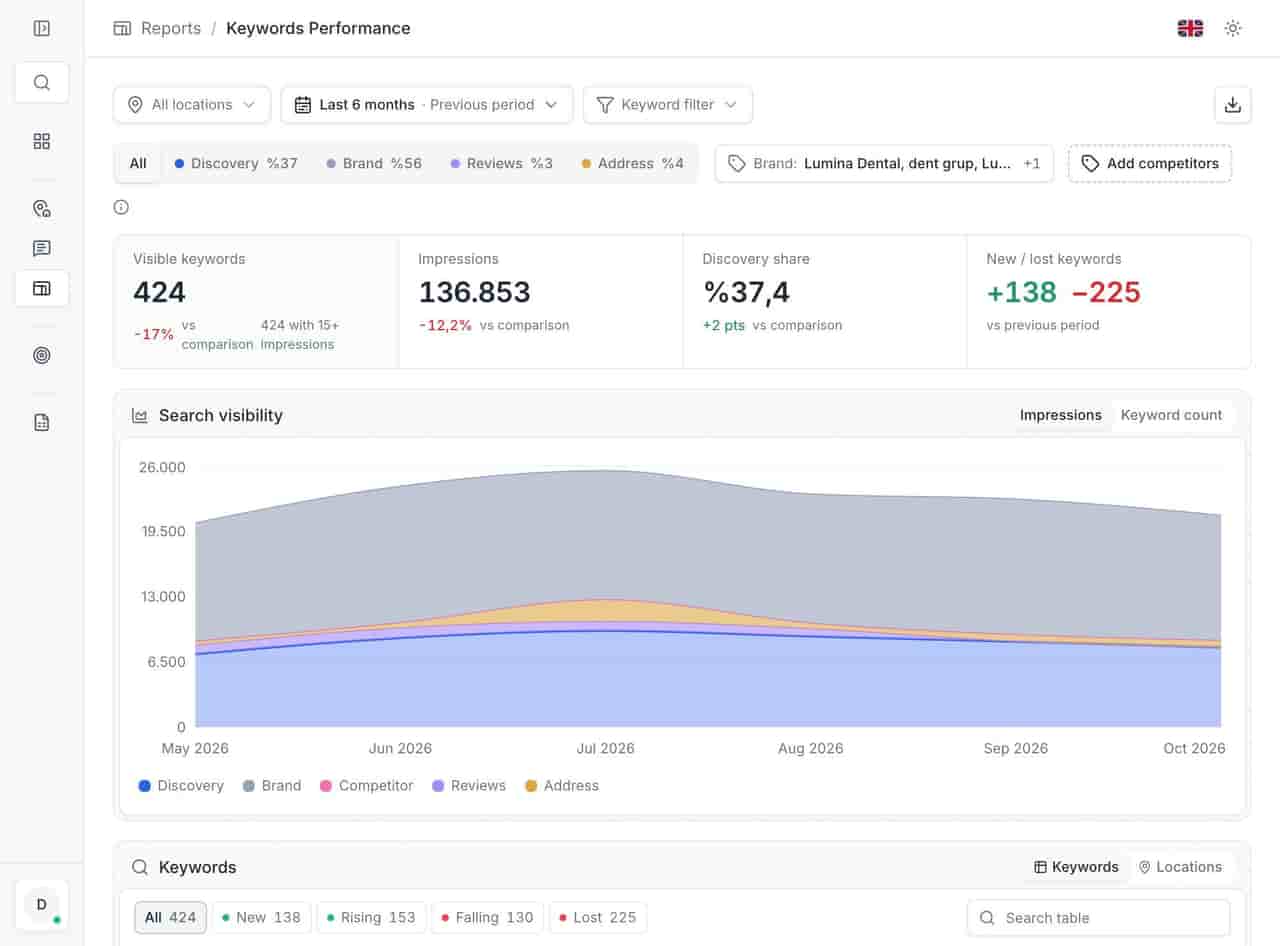
- Keywords in the demo set
- 424
- Impressions behind the visibility
- 136,853
- Locations tracked
- 23
From the anonymized 23-location demo account, November 2026. Not a customer result.
What you get
- Brand terms: the baseline you should never lose.
- Category terms: where competition happens.
- Neighbourhood terms: how nearby customers search.
- Average position for the tracked set.
01Define a set worth tracking
Define a set worth tracking
A long list makes an average meaningless. Start with three groups: your brand, your category ("dentist", "tyre fitting", "supermarket") and a couple of neighbourhood terms that reflect how people search near a store.
- Brand terms: the baseline you should never lose. - Category terms: where competition happens. - Neighbourhood terms: how nearby customers search.
- Brand terms: the baseline you should never lose.
- Category terms: where competition happens.
- Neighbourhood terms: how nearby customers search. ../assets/screenshots/report-keywords-en.jpg — Alt: "Keyword table used to choose the terms worth tracking for each location."
02Read position per location, not just the average
Read position per location, not just the average
An average of 6 can be five stores at 3 and one at 21. The per-location view shows which store is the outlier, and the map view shows whether the weak stores share a market. That is the difference between a reporting number and a decision.
- Average position for the tracked set. - Per-location position for every keyword. - A map view of where the estate is weak.
- Average position for the tracked set.
- Per-location position for every keyword.
- A map view of where the estate is weak. ../assets/screenshots/report-keywords-en.jpg — Alt: "Keyword list with location context, used to identify a ranking outlier."
03Report movement monthly
Report movement monthly
Positions move for reasons worth knowing: a profile edit, a competitor opening, a category change, a shift in the searcher's location. Read the direction over weeks, not a single day's number, and report it next to the work that was done.
- Month-on-month movement for the tracked set. - Context from keyword trends when a term moves sharply. - A stable definition for contracts and monthly packs.
- Month-on-month movement for the tracked set.
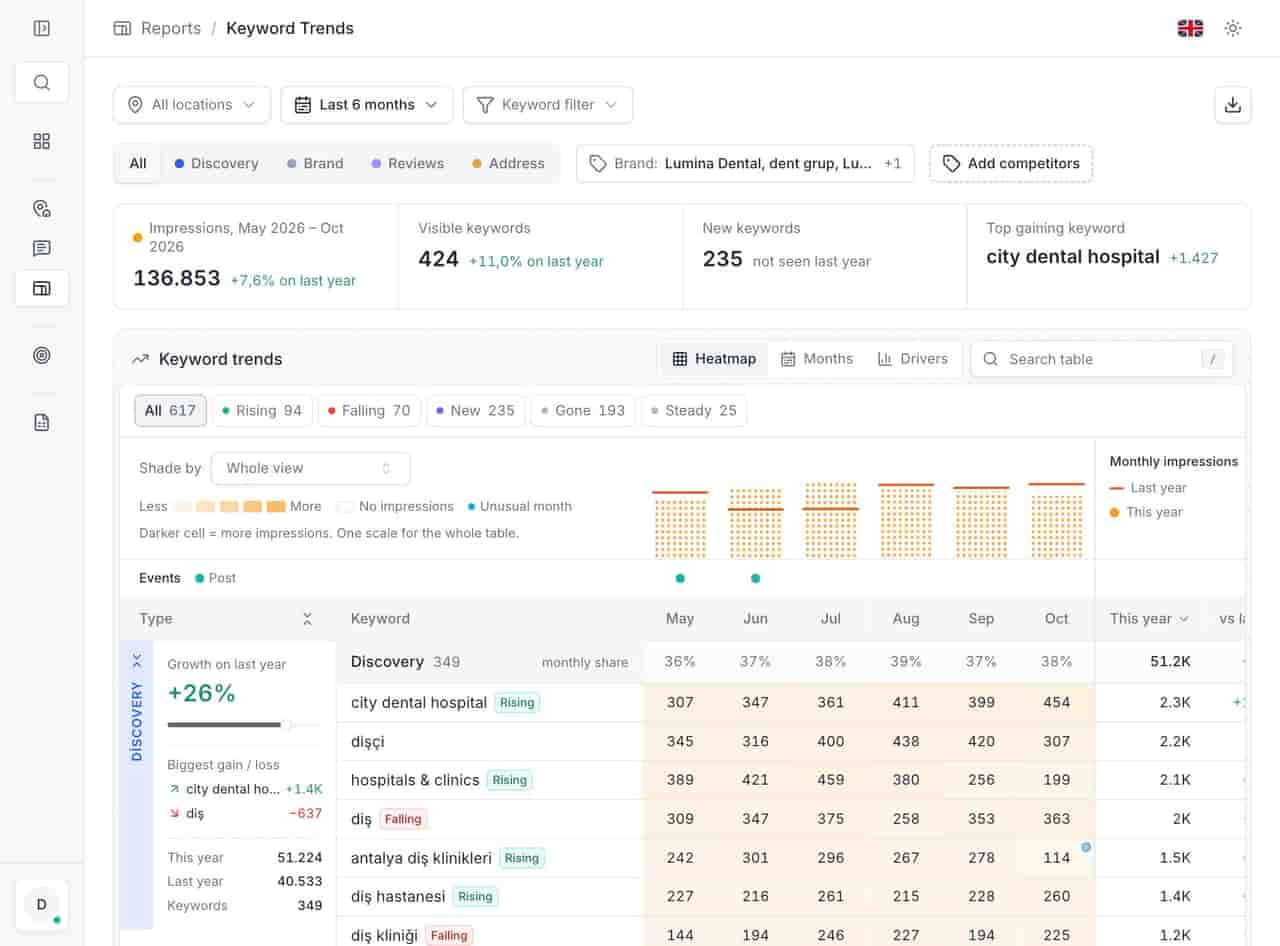
- Context from keyword trends when a term moves sharply.
- A stable definition for contracts and monthly packs. ../assets/screenshots/report-keyword-trends-en.jpg — Alt: "Keyword trend view used to explain a position change over months."
Related
Related pages
Features, sectors and reading that share the same work.
FAQ
Local rank tracking questions
How is a local position measured?
Locationes tracks the keywords you add and reports the position each location holds, with an average across the set. Local results vary by proximity and device, so the per-location view is the one to act on.
How many keywords can we track?
The set is yours to define rather than a fixed list, and it applies across locations so comparisons hold. Start with brand, category and a few neighbourhood terms; a long list makes the average meaningless.
Does it replace keyword performance?
No. Performance shows which searches produced impressions and whether they were discovery or brand; rank tracking shows position for the terms you deliberately chose. One explains demand, the other competitiveness.
Why can a position change without a profile edit?
Local results move when competitors change, when Google adjusts the layout, when reviews or photos change, and when the searcher's location changes. That is why the report is read as a direction over weeks.
Is there a screenshot of the tracking screen?
Not yet. The screen exists in the product but has not been anonymized for publication; the images here show the keyword data it draws on. A dedicated capture is required before launch.
Start with the queue you already have.
Connect one Google account and open the unanswered tab. Three days is enough to see whether the backlog is smaller on Monday.