



What is local SEO? A 2026 guide
Local SEO in 2026: how the map pack, location pages, reviews, citations and AI answers fit together, and which metrics show the work landed.
Last updated:
A hotel can rank third for "boutique hotel Istanbul" and stay invisible for "hotel near Galata Tower". Same property, same rooms, different query, different result. Local SEO is the discipline that explains the gap, and most of the work sits below the city level.
This guide covers the definition, the surfaces a local result appears on in 2026, the five parts that do the work, how to measure them without fooling yourself, and the order to fix them in. It assumes you already know what a Google Business Profile is; if not, start with what a profile actually controls.
What local SEO is
The last clause is the one teams skip. A domain-level average can look healthy while four branches carry the number and six contribute nothing. Local SEO reports at the location, because the customer chooses a location.
What makes a search local?
Three things, and they do not always arrive together. The query contains a place ("Kadıköy dişçi"), the searcher shares a location with the device, or the result set is constrained by distance. A search can be local by intent without a place name: "open now pharmacy" at 23:00 is a local query even when the words contain no geography.
Intent decides the surface. Someone comparing brands wants a website. Someone with a toothache wants the nearest clinic that answers the phone.
How is local SEO different from organic SEO?
Organic SEO competes for a position on a results page. Local SEO competes for a position inside a set that Google builds from business records, distance and reputation, and it has to be right per branch. The overlap is real: location pages are organic assets, and links help both. The difference is the unit of work. You can rank a page once. You have to keep forty profiles accurate every week.
What are the three factors Google names?
Google's published guidance on local ranking lists relevance, distance and prominence. Relevance is whether the business matches the query. Distance is how far the location sits from the searcher. Prominence is how well known and well regarded the business appears, online and offline.
Only two are workable. Relevance comes from categories, services, pages and review language. Prominence comes from reviews, links, mentions and press. Distance is a fact about the searcher, and the honest answer to a client who wants it changed is that they need a location, not an optimization.
Is local SEO only about the map pack?
No. The map pack is the most visible surface and the one most reports measure, but a local query can produce an AI summary, a set of organic pages, a hotel finder, a review snippet or a directions card. Each surface reads different evidence. A page with clear opening hours and a named neighbourhood can win the organic slot while a profile with the wrong category loses the map.
Where does AI search fit?
AI answers add a summarising layer between the query and the click. For local queries they tend to describe a shortlist, name a few businesses and cite the sources they used. The businesses that appear are usually the ones with consistent records, readable pages and recent reviews. The mechanism is not a separate ranking system with its own rules; it is another reader of the same evidence, with a preference for text it can quote.
Where a local result appears in 2026
What is the map pack?
The block of three map results that appears for many local queries, with rating, address, hours and a directions link. It is built from Business Profile data, and the order changes with the searcher's position. A rank of one at the shop door can be a rank of nine at the far end of the district.
When does a local organic page win?
When the query has informational intent attached: "how much does a dental implant cost in Istanbul", "hotel with parking in Kadıköy". Google can answer with a page rather than a map. The page that wins usually belongs to a business with a location, but the page itself does the work: a clear answer, a price range, a named area, a date.
What does an AI answer show for a local query?
Typically a short comparison, a few named places and a set of citations. The answer is assembled from pages, profiles, directories and reviews. It is unstable: the same question asked twice can produce different shortlists, and the surface matters. A summary in a chat assistant and an AI Overview inside search do not read the same index.
Why does the same query differ two streets apart?
Because distance is part of the result set, and because Google personalises with history and device location. Two people on the same street can see different map orders. This is why a single national rank is a poor KPI and why a grid, which samples many points, is a better description.
Do directories still appear?
Yes, in two roles. They are a citation source that confirms the address and phone, and they are a surface where a customer can book or compare. The ones that matter are specific to the category: hotel finders for hotels, clinic directories for clinics. A hundred generic listings add little; five accurate category listings are worth maintaining.
The five working parts
1. The profile: what does Google know about the location?
Name, category, address, hours, phone, website, services, attributes and photographs. Every field is a claim, and the customer checks it at the door. The work is accuracy first and emphasis second: the right category, the real hours, the current photograph.
A profile that is accurate but thin gives Google little to match. A profile that is rich but wrong creates a complaint. Both are fixable, in that order.
2. The pages: does every location have a URL?
A chain with one page for forty stores asks Google to guess which store serves which query. Each location needs an indexable page with its own address, phone, hours, services, staff where relevant, and a map. The page is also where you can say things a profile cannot: parking, access, the neighbourhood, what happens during a visit.
The URL pattern matters less than the consistency. Pick one, keep it stable, and link every profile to its own page rather than the homepage.
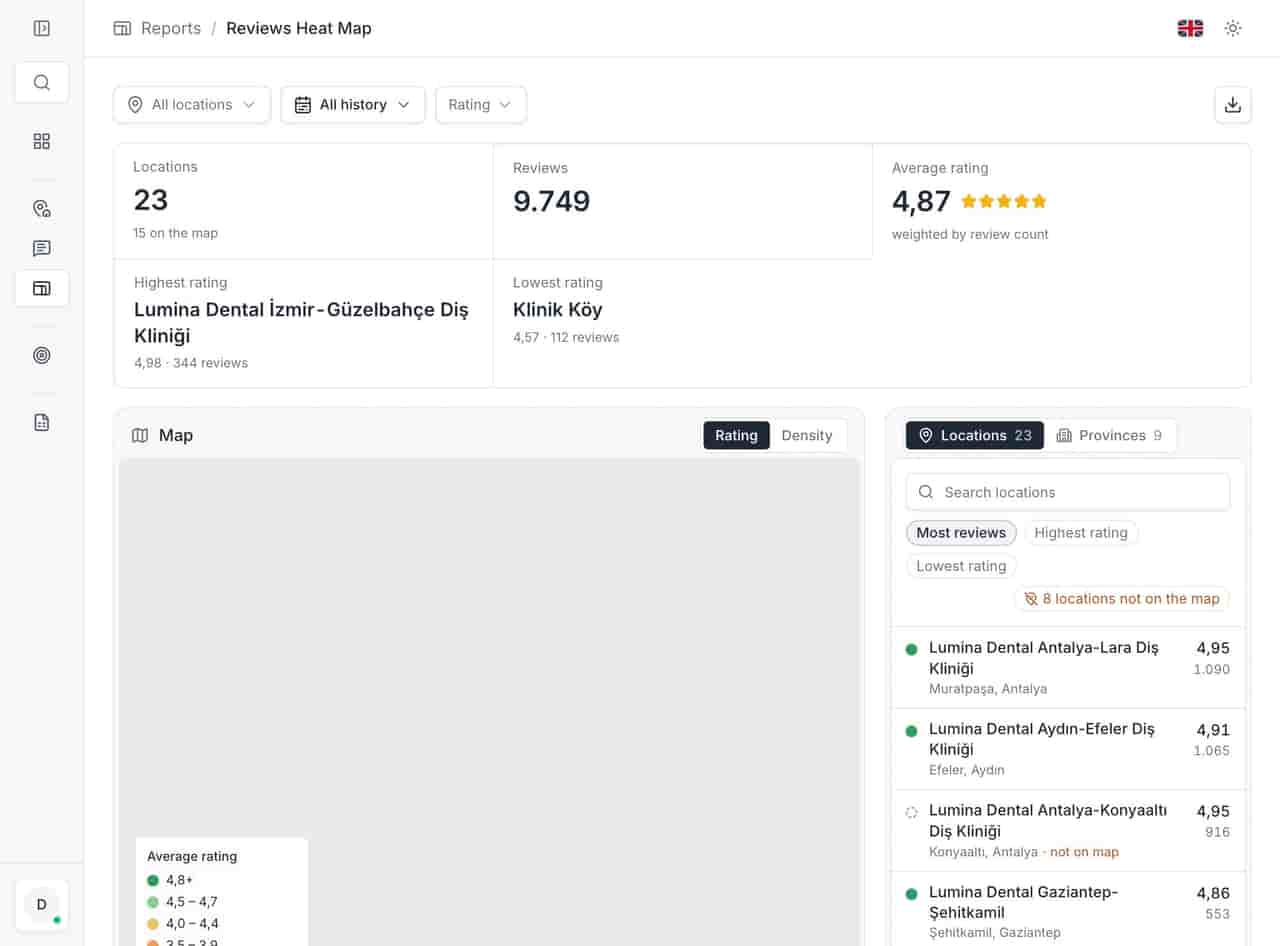
3. Reviews: what is said, and how recently?
Reviews carry two signals: the rating and the text. The rating is a summary. The text is evidence, and it is what a person reads when the rating is close between two options. Recency matters because a business with forty reviews from 2022 looks abandoned next to one with eight from this month.
Response behaviour is part of the record. A profile with no owner replies reads as unmanaged, whatever the rating.
4. Citations: does the address agree everywhere?
A citation is any mention of the name, address and phone. The goal is agreement, not volume. If the website says "Bağdat Caddesi 120" and a directory says "Bağdat Cad. 120/A", a customer can end up at the wrong door, and Google has two versions of the truth.
Fix the sources that feed others first: the website, the profile, the main category directories, the map providers. Then stop. Citation cleanup has a diminishing return, and it is never finished.
5. Links and mentions: who else names the place?
Local prominence is built by other people talking about the business: a newspaper piece, a neighbourhood association page, a supplier's stockist list, a sponsor logo on a school team, a local blog. These mentions do not need to be optimized. They need to be real, and they need to use the name a customer would search.
A handful of genuine local mentions beats a bulk order of directory links. The first is evidence. The second is furniture.
What changed in 2026
Do AI answers reduce clicks?
They can, particularly for questions with a short factual answer: opening hours, whether a place takes cards, which clinic is open now. They can also send better clicks, because the summary has already filtered the list. The honest position is that the click mix is shifting and the measurement has to include surfaces that do not pass a referrer.
Which sources get cited for local queries?
In practice, a mix of the business's own pages, its profile, review platforms and category directories. The pattern is not stable enough to optimize for a single source. What holds is legibility: a page that states the service, the area, the hours and the price in plain sentences is easier to quote than a page built from slogans.
Does schema markup improve local ranking?
There is no published ranking bonus for LocalBusiness markup. It helps machines parse the name, address, hours and services, which can improve how a result is displayed and how confidently a system describes the business. Treat it as plumbing. Useful, invisible, not a lever.
What does "near me" mean to a model?
The model rarely knows where the person is standing. It works from the query, the device context it is given, and the text of the pages. That is why explicit place names in content still matter: "walking distance from Kadıköy ferry pier" is usable by a system that cannot see the searcher.
Are directories worth the work now?
The category-specific ones, yes. They are where a customer compares and where an AI answer may find a structured list. Generic directories with no traffic are maintenance debt. Audit the list once a year, fix the wrong entries, and ignore the invitations to add forty more.
How to measure local SEO
Why is one rank number useless?
Because it describes one point. A location can be first at its door and absent at the next tram stop. Reporting "rank 1" from a city centre postcode flatters a business that serves a suburb. The number is not wrong. It answers a narrower question than the one the business asked.
What does a grid show?
A grid samples the query from many points around a location and returns a position for each. The output is a shape: where the location is strong, where it disappears, whether the weakness follows a river, a ring road or a competitor's catchment.
Local rank tracking stores the keyword set and the per-location position, and the map view turns the numbers into that shape.
Which metrics belong in a monthly report?
| Metric | Question it answers | Where it comes from | Cadence |
|---|---|---|---|
| Map position by grid point | Where are we visible? | Rank sampling | Monthly |
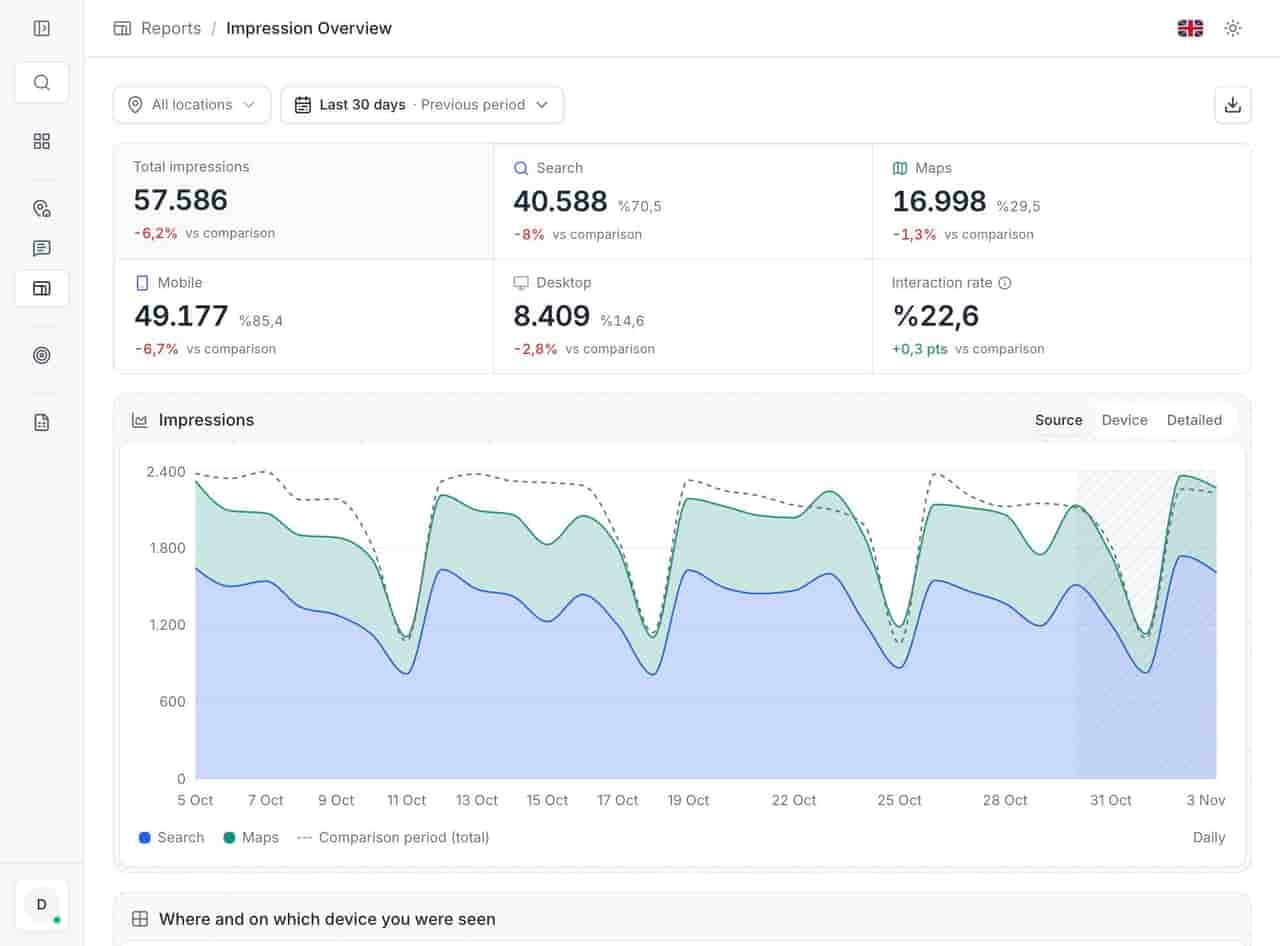
| Impressions by surface | Did visibility change? | Profile report | Monthly |
| Calls and direction requests | Did visibility become a visit? | Profile report | Monthly |
| Discovery query share | Are we found by need, not name? | Keyword report | Monthly |
| Review count and recency | Is the evidence current? | Review report | Monthly |
| Response rate and speed | Is the profile managed? | Review report | Monthly |
| Location page sessions | Does the page earn the click? | Analytics | Monthly |
| Citation mismatches | Is the record consistent? | Manual audit | Quarterly |
Four of those are leading indicators. Calls and direction requests are the lagging pair, and they are the ones a manager will ask about.
How long before a change shows?
Category and service edits can move impressions within days and settle over weeks. Review and link work compounds over months. Page changes sit in between, depending on crawl and competition. Anyone who gives a single number for all three is guessing.
What should be the baseline?
Record the grid, the impressions, the calls and the review position on the same date before changing anything. The baseline is also the answer to "was it better before?", a question that arrives in every quarterly review.
A priority order for 2026
What should a single shop fix first?
Address, hours, phone, website link. Then the primary category, then the services. These are the fields that decide whether the shop can be found and whether the customer can act. Photographs and posts come after, because they improve a listing that already appears.
What changes for a ten-location brand?
The work becomes a process. One owner for the profile fields, one for pages, one for reviews. A monthly audit that compares locations on the same criteria. A rule about which fields are shared and which are local. Without that, the estate drifts: one branch updates its holiday hours, nine do not.
Where does content fit?
Content earns the queries a profile cannot hold: cost questions, comparisons, "how long does it take", neighbourhood guides. Write it at the location level when the answer differs by location, and at the brand level when it does not. A generic article repeated across forty subdomains helps nobody.
When is the problem operational?
When the profile is accurate and the reviews still complain about the same thing. Wrong hours, unanswered phone, a queue at the door: these are operations problems wearing a marketing costume. No amount of profile work fixes a closed kitchen.
Definitions that mislead
Is local SEO the same as profile work?
No. The profile is the most concentrated asset, and it is where most local searches end. Pages, reviews, citations and mentions sit outside it, and a profile-only programme plateaus once the fields are accurate.
Is local SEO paid?
The map pack and local organic results are unpaid. Local Services Ads and paid map placements are separate products with their own rules. A business can buy visibility, and it still needs the profile to convert the click.
Does a virtual office work?
Sometimes, for a genuine back-office presence, and only where the address can receive mail and the category allows it. A virtual address used to manufacture proximity is a suspension risk and a customer service problem. Google's guidelines on representation are the place to check, not a forum.
Can a service-area business rank without an address?
Yes, with a service area and a hidden address, provided the business genuinely travels to customers. The profile then competes on the areas it serves rather than a pin. The pages should name those areas, and the reviews should mention them.
Checklist before you call it done
- Every location has its own indexable page with address, hours and phone.
- Profile name matches the sign, and the primary category matches the customer's phrase.
- Services are written in customer language, with a description each.
- Holiday hours are entered before the holiday, not on the morning.
- The website link opens the location page on a phone.
- Reviews from the last quarter mention the priority services.
- Every negative review has a reply and a named owner.
- Name, address and phone agree on the site, the profile and the top five directories.
- At least three genuine local mentions exist and are linked.
- The grid baseline is recorded with a date.
- The monthly report separates discovery queries from brand queries.
- LocalBusiness markup matches the visible address and hours.
The part that stays true
Local SEO is a records problem before it is a content problem. The business that wins the map usually has the most accurate record, the most recent evidence and the clearest page for the place a customer typed. Tools change; that order does not.
If you run hotels, the hotel guide applies the same five parts to seasonal rates and booking behaviour. For the measurement layer, impressions and interactions shows whether the visibility turned into calls and direction requests, and the local rank tracking guide explains how to sample a grid without over-reading it.
Questions, answered.
Is local SEO the same as Google Business Profile work?
How long does local SEO take?
Does local SEO work without a physical address?
See how the deleted reviews archive keeps the record, including the reply.
FeaturesKeep reading
Related
Related pages
Features, sectors and reading that share the same work.