



Hyperlocal SEO: visibility at neighbourhood level
Win searches for a district, street or landmark: finer rank grids, neighbourhood pages with real local facts, review language and the traps to avoid.
Last updated:
A clinic can hold the top spot for "dentist in Istanbul" and lose every search from the next postcode. The city query rewards a strong domain. The neighbourhood query rewards a strong record of that specific place, and the two are built differently.
Hyperlocal SEO is the layer below city-level local SEO. It is where a chain discovers that one branch is invisible inside its own catchment, and where a single shop with no marketing budget can beat a national brand on the street it actually serves.
What hyperlocal SEO means
The definition has a hard edge. A neighbourhood is not a content category you invent for SEO. It is a set of streets that customers already use to describe where you are, and the work starts by listening for those names.
How is it different from local SEO?
Local SEO asks whether a business is visible when someone searches with a city in mind. Hyperlocal asks the same question one level down, where distance and walking routes matter more than domain authority. The methods overlap: both need an accurate profile and real reviews. The measurement differs. A city-level rank can be checked from one point. A neighbourhood rank has to be sampled across a small area, because the answer changes at the end of the street.
When does neighbourhood level matter?
Four situations, in practice:
- Dense cities where districts have their own shopping streets and locals rarely cross a river for a haircut.
- Categories with a short travel tolerance: bakeries, barbers, physiotherapy, nurseries, coffee.
- Delivery and catchment businesses whose service area is a set of postcodes.
- Chains where two branches sit close enough to compete for the same query.
If the category draws customers from a whole city, hyperlocal work still helps at the edges of the catchment. It rarely justifies a page per postcode.
When is it a waste of time?
When the demand is not there. A specialist clinic that draws patients from three provinces does not need ten neighbourhood pages; it needs one strong page and a clear statement of the catchment. Hyperlocal also fails when the business cannot serve the area it writes about. A page for a district you do not cover produces a click and a refund request.
What is a neighbourhood, for search purposes?
The name customers type. That might be an official district, a colloquial area, a street famous for a trade, or a landmark. In Istanbul, "Bağdat Caddesi" and "Kadıköy" pull different queries and different intent. The practical test: listen to how customers give directions on the phone. Those words belong in the content; the municipal boundary belongs in a spreadsheet.
The unit of work
Should you use official district boundaries?
Use them for reporting, not for content. Boundaries are stable and useful when you compare branches or allocate a budget. Customers do not experience a boundary; they experience a high street, a park, a station. A page built around an administrative map reads like a government document, and it misses the names people search.
What radius fits which category?
There is no universal radius. A bakery draws from a few minutes on foot. A dental clinic draws from a wider ring, and a hospital from the whole city. Pick the radius by asking how far a customer will travel for the service, then sample inside it. If the answer is "it depends", sample two rings: walking distance and a short drive.
How do delivery zones change the map?
For a restaurant or a grocery, the service area is a polygon, not a circle. The polygon follows postcodes, motorways and rivers, and it changes how a profile should describe itself. A neighbourhood page that promises delivery outside the polygon creates a complaint the kitchen cannot fix. Publish the zone, test the boundary addresses, and keep the profile's service area aligned.
How many pages does one location need?
One page per location is the minimum. Neighbourhood pages are justified when the location serves several distinct areas with different queries and genuinely different answers: parking, access, delivery time, the nearest landmark. A branch with one catchment needs one page. A branch at the seam of three districts, each with its own search behaviour, can justify three.
Pages that deserve to exist
What belongs on a neighbourhood page?
The address of the location that serves the area, the travel time from a named landmark, the services available there, parking and access, hours, and a booking action. Then the local detail a customer cannot get from the homepage: which entrance to use, where the buggy goes, what the queue looks like on a Saturday.
A page that only swaps the district name into a template has no reason to exist. The test is whether a local resident would learn something.
How do you avoid ten identical pages?
Give each page a different question to answer. One district page is about parking, another about the school run, a third about late opening. That difference has to come from the location, not from a writer's imagination. Ask the branch manager what customers ask on the phone, and answer that.
A useful constraint: if two pages could be swapped without a customer noticing, merge them.
Which landmarks are safe to name?
Public, stable and well known: a station, a square, a hospital, a stadium, a bridge, a shopping street. Avoid naming a business that might close, and avoid implying an endorsement. "Two minutes from Kadıköy ferry pier" is safe. "Next to X Cafe" dates quickly and can read as a paid placement.
How should the URL be structured?
Keep the location stable: /locations/kadikoy and, if needed, /locations/kadikoy/bagdat-caddesi. Do not encode the service into the URL for every combination; that is how a site ends up with forty near-duplicate pages. A readable hierarchy also survives a redesign, which a query-string mess does not.
What internal links does the page need?
Three kinds. Up to the location page, so the branch is the canonical source of address and hours. Across to the services offered there, so the page is not a dead end. And sideways to genuinely adjacent neighbourhoods, where a customer might plausibly cross over. A block of links to twenty districts teaches a search engine that the pages are interchangeable.
When should a page be merged or deleted?
When it has no unique answer, no local links, no traffic and no bookings after a reasonable period. Merge the useful paragraphs into the location page and redirect. Keeping a thin page alive because it took an afternoon to write is how sites accumulate the pages that dilute the rest.
Signals at this scale
Do reviews need street names?
They need the words customers actually use. A review that says "healed my back, five minutes from the market" tells a reader more than "great service". You cannot script that, and you should not. What you can do is ask at the right moment and reply in the same language, naming the service and the area when it is true.
Does the pin matter more here?
Yes. At city scale, a pin twenty metres off changes nothing. At neighbourhood scale, it can put a customer on the wrong side of a one-way system. Check the pin against the entrance, then check the walking route a phone produces. If the route sends people through a wall, the pin or the access note is wrong.
What do local mentions look like?
A sponsor line on a school football kit. A neighbourhood association page listing the shop. A local newspaper piece about a refurbishment. A supplier's stockist list with the street address. These are small, and they are exactly what a hyperlocal query needs: independent confirmation that the business belongs to the area.
Do photos carry neighbourhood evidence?
They can. A photograph of the shopfront with the street visible, the park opposite, the station exit, the bus stop, answers "where exactly?" without a paragraph. Keep the sign legible and the season current. A summer terrace photo used in January is a small lie the customer notices at the door.
How do you describe an area without a storefront?
Describe the service polygon and the travel pattern: which districts you cover, how quickly you arrive, where the boundary sits. Name the areas you genuinely serve and link to a page that explains the coverage. Reviews from customers in those areas do the rest. A hidden address does not mean a hidden catchment.
Measuring a neighbourhood
Why does a city average hide the answer?
An average across a city is dominated by the strongest points. A branch can be first in its own street and absent two kilometres away, and the average still looks respectable. The problem is not the number; it is the resolution. You cannot manage a catchment you cannot see.
What does a fine grid cost?
More sampling points and more time per keyword. A city grid might use a handful of points; a neighbourhood grid needs enough points to show the edge of visibility, often a few hundred metres apart. The cost is operational, not financial: someone has to choose the keyword set and read the shape rather than the average.
Local rank tracking keeps the keyword set per location and plots the points on a map, which is the practical way to see where a branch disappears.
How do you compare two branches in one city?
Use the same keyword set, the same grid density and the same date. Then compare the shapes, not the averages. One branch may be strong around a station and weak in the residential streets; another may be the reverse. That comparison is what a relocation or a local campaign decision needs.
Which queries belong in the set?
Three groups: service plus district, service plus landmark, and service near me. Add the brand query as a control. Keep the set small enough to read. Twenty queries across five locations is already a hundred series, and nobody reviews a hundred series carefully.
How often should the grid run?
Monthly for a stable estate, weekly during a move, a refurbishment or a local campaign. The cadence should match the decision cycle. A weekly grid that nobody reads is worse than a monthly one that produces an action.
| Layer | Question | Evidence | Cadence |
|---|---|---|---|
| Profile accuracy | Is the record right at the door? | Audit | Monthly |
| Neighbourhood grid | Where do we disappear? | Rank sampling | Monthly |
| Local queries | Which streets and landmarks appear? | Keyword report | Monthly |
| Reviews | Do customers name the area? | Review text | Monthly |
| Local mentions | Who else names the place? | Manual search | Quarterly |
| Neighbourhood pages | Do they earn sessions and bookings? | Analytics | Monthly |
| Competitor shape | Who owns the next street? | Grid comparison | Quarterly |
Content that AI answers quote
What makes a paragraph citable?
Specificity and a plain sentence. "We are a two-minute walk from Kadıköy ferry pier, with step-free access from the side street" can be quoted. "We are committed to excellence in a prime location" cannot. AI summaries favour text that answers a question without requiring the reader to hold three clauses in mind.
Should you publish parking and access details?
Yes, at the level of the individual location. Parking is one of the most common pre-visit questions and one of the least answered on chain websites. Say where the car park is, what it costs, how long the walk takes, and whether the entrance has steps. Update it when the council changes the parking rules.
How do you keep pages current without rewriting them?
Maintain a small block of facts with a date: hours, access, travel time, the nearest landmark, current services. Review it quarterly and after any change to the street. The rest of the page can stay stable. Freshness that matters is factual freshness, not a new intro paragraph every month.
Mistakes
Why do doorway pages fail?
Because they exist for a query and not for a customer. A page that lists twenty districts, swaps the name and repeats the same three sentences is recognisable to a reader and to a system that compares pages. The failure is not a penalty you can appeal; it is a page nobody trusts.
Why does spinning one paragraph fail?
Rewording the same facts produces the same page. Local content needs local facts: the parking, the entrance, the school, the market day, the bus. If you do not have those facts, the page is not ready. Ask the branch, or wait.
What happens when pages cannibalise each other?
Two pages compete for the same query, and neither wins consistently. The symptom is a page that ranks for a week, disappears, and is replaced by its sibling. The fix is consolidation: pick the page with the better evidence, merge the unique parts, redirect the other.
Can a hyperlocal page hurt a nearby branch?
Yes, if it claims coverage the branch does not have, or if it pulls a booking the other branch cannot serve. The customer arrives, the service is unavailable, and the review lands on the wrong profile. Hyperlocal content has to follow operational reality, including which branch answers the phone.
Checklist before publishing a neighbourhood page
- The district name is one customers actually use on the phone.
- The page names the branch that serves the area, with a link to its location page.
- Travel time is given from a stable public landmark.
- Parking, access and entrance details are specific and current.
- At least one fact on the page could only come from that branch.
- The page does not claim coverage outside the service polygon.
- The keyword set for the area is recorded with a grid baseline.
- Replies to reviews from the area name the service and the place where that is true.
- At least one genuine local mention exists.
- The page is linked from the location page and one adjacent area.
- No other page on the site targets the same district and service.
- A date is attached to the facts block, and a review date is set.
The street is the unit
Hyperlocal SEO rewards the business that can describe a place accurately. Not the one with the most pages, and not the one with the cleverest keyword variant. A correct pin, a page with real local facts, reviews that name the area and a grid that shows where visibility ends will outperform a template rolled out across forty districts.
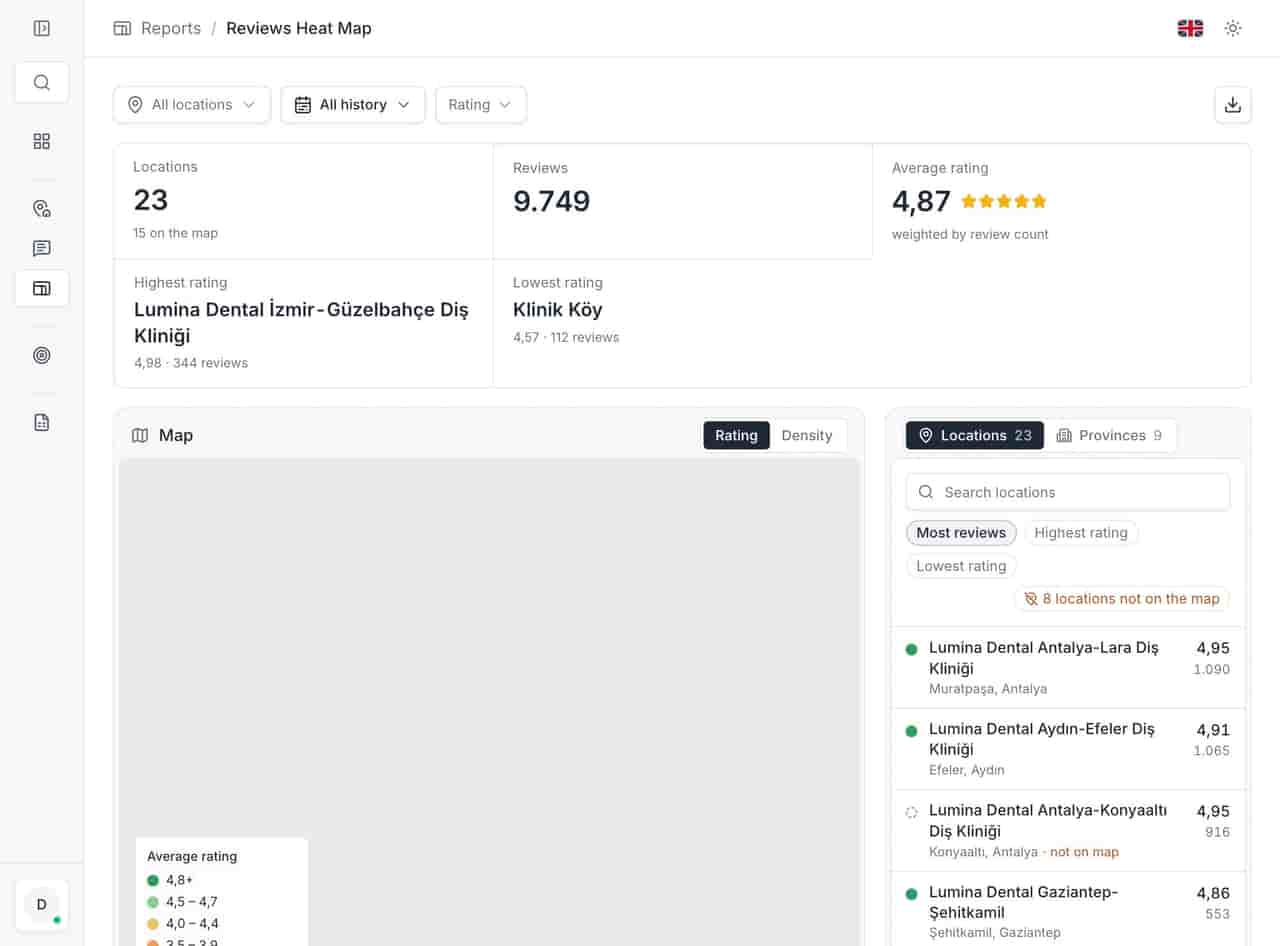
Start with one branch where the gap is visible. The reviews heat map shows whether weak ratings cluster in a district, which is often the first clue that the problem is geographic. For the layer above, what local SEO means in 2026 explains how neighbourhood work fits the city-level plan. If you run salons, the salon guide applies the same method to walk-in catchments.
Questions, answered.
How is hyperlocal SEO different from local SEO?
How many neighbourhood pages should one location have?
Do neighbourhood pages still work with AI search?
See how the deleted reviews archive keeps the record, including the reply.
FeaturesKeep reading
Related
Related pages
Features, sectors and reading that share the same work.